
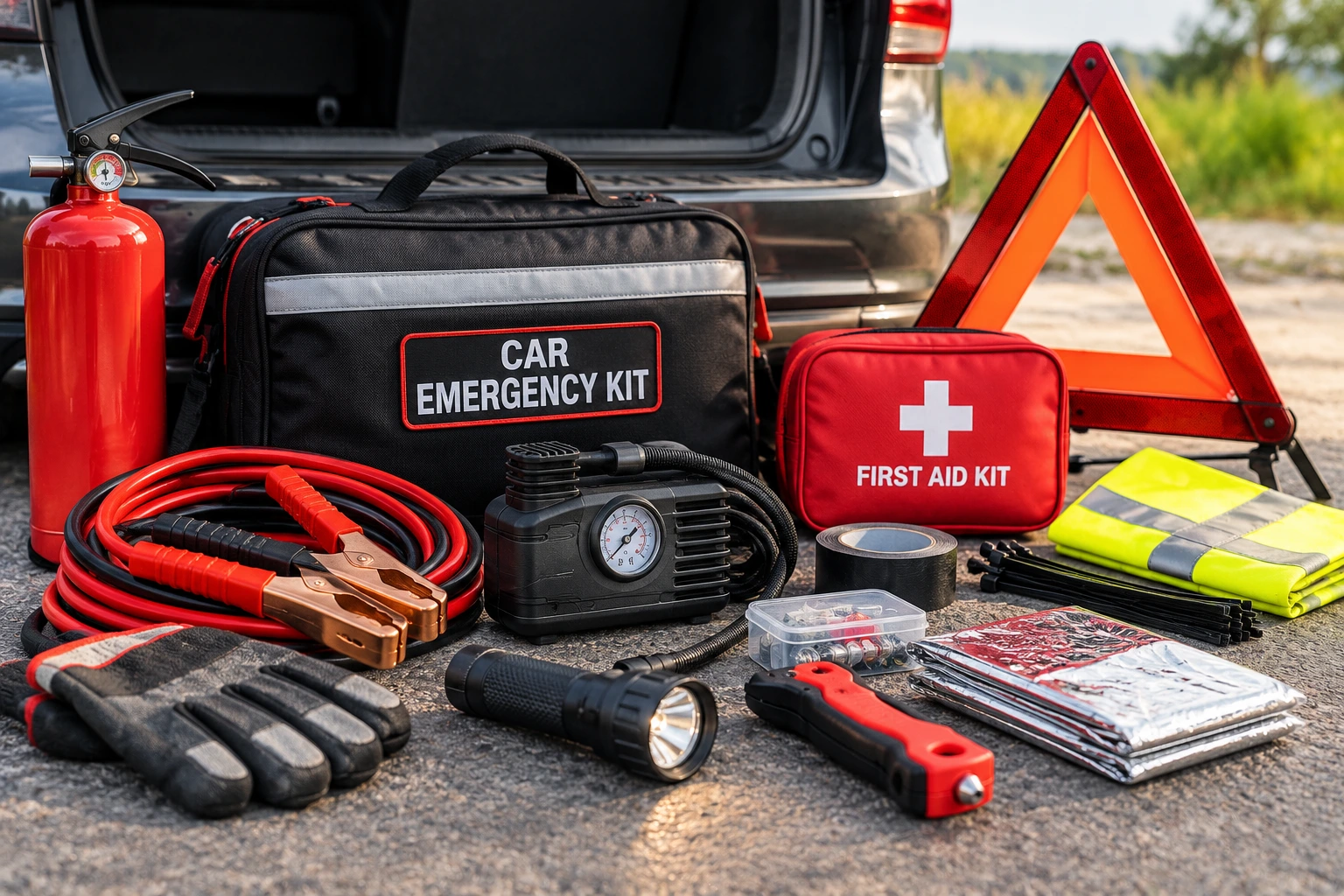
A car emergency kit only needs items that pass three tests: you can reach them fast, they survive a year of heat and cold in a trunk, and they do something you cannot improvise. That means a visibility set, a glass-appropriate escape tool, a seatbelt cutter, a charged light, a traction aid and a tow strap earn space more reliably than most bundled kits sold as one box.
Reviewed: August 2026. This guide covers year-round, general-climate driving. It does not cover a deep-winter or extreme-cold kit, and it does not walk through the minute-by-minute sequence of what to do in the first minutes of a breakdown. For that specific choreography, AAA or your own roadside assistance provider has the current, right-and-wrong-answer guidance, and this article routes you there rather than guessing.
The Three Tests an Item Must Pass
Nearly every “car emergency kit” list on the internet is the same exercise: pile up everything that sounds plausible, add a bullet point, move on. Almost none of them apply a filter. Here is one that actually works: an item earns its space only if it passes all three of these tests.
Can you reach it when you need it? A tool buried under a spare tire, wedged behind a subwoofer box, or packed at the bottom of a stuffed trunk organizer might as well not exist during a roadside emergency. Reach is a placement decision, not a shopping decision, and it decides more about whether a tool actually helps than the tool’s own quality does.
Will it still work after a year in a hot or cold trunk? A trunk swings through a much wider temperature range than a glovebox or a cabin ever does. Plastics crack, adhesives fail, batteries degrade faster under heat, and cheap components that felt fine in a showroom can be brittle or dead a year later.
Does it do something you cannot improvise? A seatbelt cutter does something a fingernail and panic cannot. A warning triangle does something your hazard lights alone do not, since a fixed reflective shape reads differently to an approaching driver than a blinking light does. A lot of standard kit filler, a tiny toy hammer, a paper pamphlet, a folding shovel too large to actually stow, fails this test even before the other two come into play.
Getting Seen Comes Before Everything Else
Visibility is the most underrated category in this whole space, and it is the one most kit lists treat as an afterthought behind tools and repair items. Before anything else in this list matters, an approaching driver needs to see your vehicle and understand it is stopped, not slow.
Exactly how and where you position yourself, your vehicle and your warning devices at a specific roadside stop is a procedure with real right and wrong answers that depend on the road, the shoulder width and the traffic around you. That specific sequence belongs to AAA’s own published guidance or your roadside assistance provider, not a gadget list, and this article stops at naming what the devices do rather than walking through when and where to use them.
What the devices themselves do differs more than most drivers assume. A reflective warning triangle works passively, it needs no power and no line of sight to your vehicle to be understood. An LED beacon adds its own light source, which matters more in low visibility or at night, and the honest tradeoff between the two is covered in the warning triangles, flares and LED beacons comparison. A reflective vest does a different job again: it makes the person, not just the vehicle, visible to approaching traffic, which matters the moment you step outside the car at all, and that case is made fully in the roadside safety vest guide.
Getting Out, and the Glass Question
If a vehicle enters water or a door will not open, the tool that matters is an escape tool, and the honest answer starts with a question most kit shoppers never think to ask: what kind of glass does your car actually have?
AAA’s 2019 testing of six escape tools, three spring-loaded and three hammer-style, found that four of the six could break tempered glass, while none of the six could break laminated glass. That is not a small footnote. AAA’s research also found that roughly one in three 2018 model year vehicles already used laminated side glass, a figure that has only grown as manufacturers use laminated glass more widely to reduce occupant ejection risk in a crash. A tool that works reliably on one glass type does nothing on the other, and no escape tool on the market currently breaks laminated glass reliably.
That makes the real first step checking your own vehicle, not shopping for a tool. Many vehicles carry a small marking in the corner of the side window indicating the glass type; if you cannot find or read it, your vehicle manufacturer can confirm which glass your specific windows use. The full walkthrough of what to look for is in tempered or laminated: how to check your own side windows, and the deeper look at how escape tools performed in AAA’s testing, and what that means for choosing one, is in car escape tools: what breaks tempered glass and what doesn’t.
A seatbelt cutter is the part of this category that sidesteps the glass question entirely, since it does not depend on what the window is made of. Half the tool, the belt-cutting half, works every time regardless of glass type, which is exactly why it earns its own entry rather than a footnote on the escape tool page; see seatbelt cutters: the half of the tool that always works.
Getting Going Again
Getting stuck and getting disabled are two different problems, and the gadgets that solve them are different too. A wheel spinning in snow, mud or sand usually needs traction under it, not a pull from another vehicle. Traction boards or mats give a spinning tire something to bite into, and the honest limits of what they can and cannot free you from are covered in the traction boards and mats guide.
A tow or recovery strap is a different tool for a different situation: a vehicle that genuinely cannot move under its own power and needs another vehicle to pull it clear or to a safer spot. This is one of the few items in a roadside kit with a real, physical failure mode if used wrong, since exceeding a strap’s rated capacity or attaching to a point not designed to take that load can cause a sudden, dangerous failure. Every strap carries its own rated capacity printed or tagged on it, and every vehicle has specific tow points rated for recovery use, both of which you should confirm against the strap’s own label and your owner’s manual before ever using one, not against a number in this article. The full breakdown of what a driver should and should not attempt with a strap is in tow and recovery straps: the limits a driver should respect.
Neither of these solves a flat tire or a dead 12V battery. If the reason you are stopped is air pressure rather than traction, that is a portable inflator’s job, covered in how to choose a portable tire inflator. If the reason is a battery that will not turn the engine over, that is a jump starter’s job, covered in how to choose a portable jump starter. Both are different device categories from anything in this kit, worth carrying alongside it, not instead of it.
Getting Warm, Dry and Lit
This is a year-round, general-climate guide, not a deep winter or Nordic-conditions kit, so the items here are the ones that earn space regardless of season: a compact rain layer, a light blanket, and a charged, hands-free light source. A dead phone flashlight or a fumbled hand-held light is a common, avoidable failure at exactly the moment visibility and both hands matter most.
A dedicated work light or headlamp solves a problem a phone flashlight solves poorly: it frees both hands for whatever you actually need to do, whether that is checking a tire, placing a warning device, or simply being visible while you wait. What actually distinguishes a work light worth keeping from one that will not survive a year of glovebox heat and cold is covered in work lights and headlamps for a roadside stop.
Where Each Item Actually Lives
The first of the three tests, reach, is really a placement question, and placement is where most bundled kits quietly fail even when every individual item is good. A glovebox holds what you need within seconds without leaving your seat: a seatbelt cutter, a compact light, a tire pressure gauge, basic documents. A trunk holds what is bulkier or only needed once you are already outside the vehicle: traction boards, a tow strap, a warning triangle or beacon, a reflective vest.
Splitting a kit across both locations by what each item is actually for, rather than dumping everything into one bag, is the single biggest difference between a kit that helps in the moment and one that just exists. The full breakdown of what belongs where, and why, is in glovebox vs trunk: where each emergency gadget belongs.
The Battery Problem Across the Whole Kit
A meaningful share of a modern emergency kit now depends on its own battery: an LED beacon, a work light, a portable jump starter if you carry one alongside this kit, sometimes even a tire inflator. A flat battery inside a device you are counting on defeats the entire point of carrying it, and it is a failure that hides perfectly until the moment you actually need the device.
This is a maintenance habit, not a one-time purchase decision, and it is worth treating that way explicitly rather than assuming a device will simply be ready months after you bought it. The specific routine for keeping battery-powered emergency gadgets actually charged is in emergency gadgets that need charging: keeping the kit alive, and the same storage-and-recharge discipline applies to a jump starter kept in the same kit, covered separately in how to store a jump starter.
What Most Kit Lists Include That Fails the Tests
Run a typical bundled “72-piece emergency kit” through the three tests above and a surprising amount of it fails. A tiny fold-out shovel too large to fit anywhere reachable and too flimsy to actually dig with fails reach and the improvise test at once. A paper first aid pamphlet degrades in a hot trunk and tells you nothing your phone cannot already look up. A dollar-store multitool with plastic-handled pliers is exactly the kind of part that goes brittle after a summer in a closed trunk. Cheap tire sealant, marketed as a fix-all, often cannot address a sidewall puncture or a damaged wheel at all, and using it can complicate a later repair or replacement, so it belongs in a different, narrower conversation than this one, not a blanket recommendation here.
None of this means bundled kits are worthless as a starting point. It means the honest move is treating a bundled kit as a base to audit against the three tests, not a finished answer, and swapping or relocating whatever fails.
A Kit Item Against the Job It Does and Where It Belongs
| Item | Job it does | Where it typically lives |
|---|---|---|
| Warning triangle or LED beacon | Makes the stopped vehicle visible to approaching traffic | Trunk, near the opening for fast access |
| Reflective vest | Makes the person, not just the vehicle, visible | Trunk or driver door pocket |
| Escape tool (glass-appropriate) | Breaks tempered side glass in an emergency | Within arm’s reach of the driver’s seat |
| Seatbelt cutter | Cuts a jammed belt regardless of glass type | Glovebox or center console |
| Traction board or mat | Gives a spinning wheel something to bite into | Trunk, flat storage |
| Tow or recovery strap | Lets another vehicle pull yours within its rated limits | Trunk |
| Work light or headlamp | Frees both hands, replaces a fumbled phone flashlight | Glovebox, kept charged |
| Compact rain layer and light blanket | Basic warmth and dryness while you wait | Trunk |
| Charged phone and saved roadside number | Connects you to actual help | On you, always |
What a Gadget Cannot Do
This is worth saying plainly, because it is the section most kit sellers skip entirely: the single most reliable thing in this whole category is not a device at all. It is a charged phone with your roadside assistance provider’s number saved, or a working AAA membership, or your insurer’s roadside line. Every gadget in this guide helps with one specific, narrow job. None of them replaces judgment about when a situation is beyond what any tool in a trunk can fix, and none of them substitutes for professional emergency services when a situation calls for one.
If you are ever unsure whether a roadside situation needs a tool or a call, make the call first. For the specific sequence of what to do in the first minutes of a breakdown, where to stand, when it is safer to stay in the vehicle versus leave it, and who to contact first, that guidance belongs to AAA or your own roadside assistance provider, and their current advice should always take priority over a general article like this one.
Deep Dives
This pillar is the entry point to Cluster 6. Each spoke below goes deeper into one part of the kit than a pillar can:
- Car escape tools: what breaks tempered glass and what doesn’t, AAA’s testing in full.
- Tempered or laminated: how to check your own side windows, before you buy an escape tool.
- Seatbelt cutters: the half of the tool that always works.
- Warning triangles, flares and LED beacons compared.
- Reflective vests and being seen at the roadside.
- Work lights and headlamps for a roadside stop.
- Tow and recovery straps: the limits a driver should respect.
- Traction boards and mats: getting unstuck without a tow.
- Glovebox vs trunk: where each emergency gadget belongs.
- Emergency gadgets that need charging: keeping the kit alive.
For the general framework this whole site applies to any car gadget purchase, see how to choose car accessories.
FAQ
What are the real essentials for a car emergency kit?
A glass-appropriate escape tool, a seatbelt cutter, a visibility set (warning triangle or LED beacon plus a reflective vest), a charged work light, a traction aid and a tow strap, split between the glovebox and trunk by how fast you need to reach each one. Judge anything beyond that list against the three tests: reach, climate durability, and whether it does something you cannot improvise.
Do I need a special tool to break my car’s window in an emergency?
It depends on your vehicle’s glass. AAA’s 2019 testing found that some escape tools can break tempered glass while none of the tools tested could break laminated glass, and laminated side windows have become more common. Check your own vehicle’s glass type before assuming any tool will work.
Is duct tape or a basic tool kit worth keeping in the car?
General-purpose tools and tape can be genuinely useful for minor repairs, but they are not emergency-kit essentials in the same sense as the items above, since a screwdriver or tape does not do anything you could not otherwise improvise or wait for a professional to handle.
Do I need a different kit for winter?
This guide covers a year-round, general-climate kit. Extreme cold and deep-winter conditions call for additional, climate-specific preparation beyond what is covered here, and that guidance is worth seeking from a source focused specifically on cold-weather driving.
What should I do first if my car breaks down?
The specific first-minutes sequence, where to position your vehicle and yourself, when to stay inside versus step out, and who to call, is guidance with real right and wrong answers depending on the road and your situation. AAA and most roadside assistance providers publish current, detailed guidance on exactly this, and it should be your first stop, not a general gadget guide.
How much weight does a proper emergency kit add to a car?
It varies by what you carry and your specific vehicle, so there is no single honest number to give here. As a general practice, keep bulkier items like traction boards in the trunk rather than the cabin, and check your own vehicle’s payload and cargo guidance in the owner’s manual if you are combining a kit with other regularly carried cargo.
Are bundled “emergency kit” boxes worth buying?
They can be a reasonable starting point, but treat the contents as a base to audit against the three tests in this guide rather than a finished answer. Several common bundled items, a tiny shovel, a paper pamphlet, a cheap plastic multitool, tend to fail on reach or climate durability once you actually check.