
Yes, once you know the correct order: connect positive first, then ground the negative lead to bare metal away from the battery, and use a permanently mounted ring-terminal pigtail rather than clips if you plan to leave it for weeks. Keep the charging unit itself out of the engine bay and off wet ground, and make sure the battery has normal air movement around it before you walk away.
This describes the standard method for connecting a smart battery maintainer, the kind built to stay attached unattended, not a specific test performed for this article. Your unit’s own manual is the authority for its exact settings and connection points, especially for AGM, gel, sealed, or lithium batteries, which can call for a different mode or setting than a standard flooded lead-acid battery.
Connection order and why the ground clamp goes away from the battery
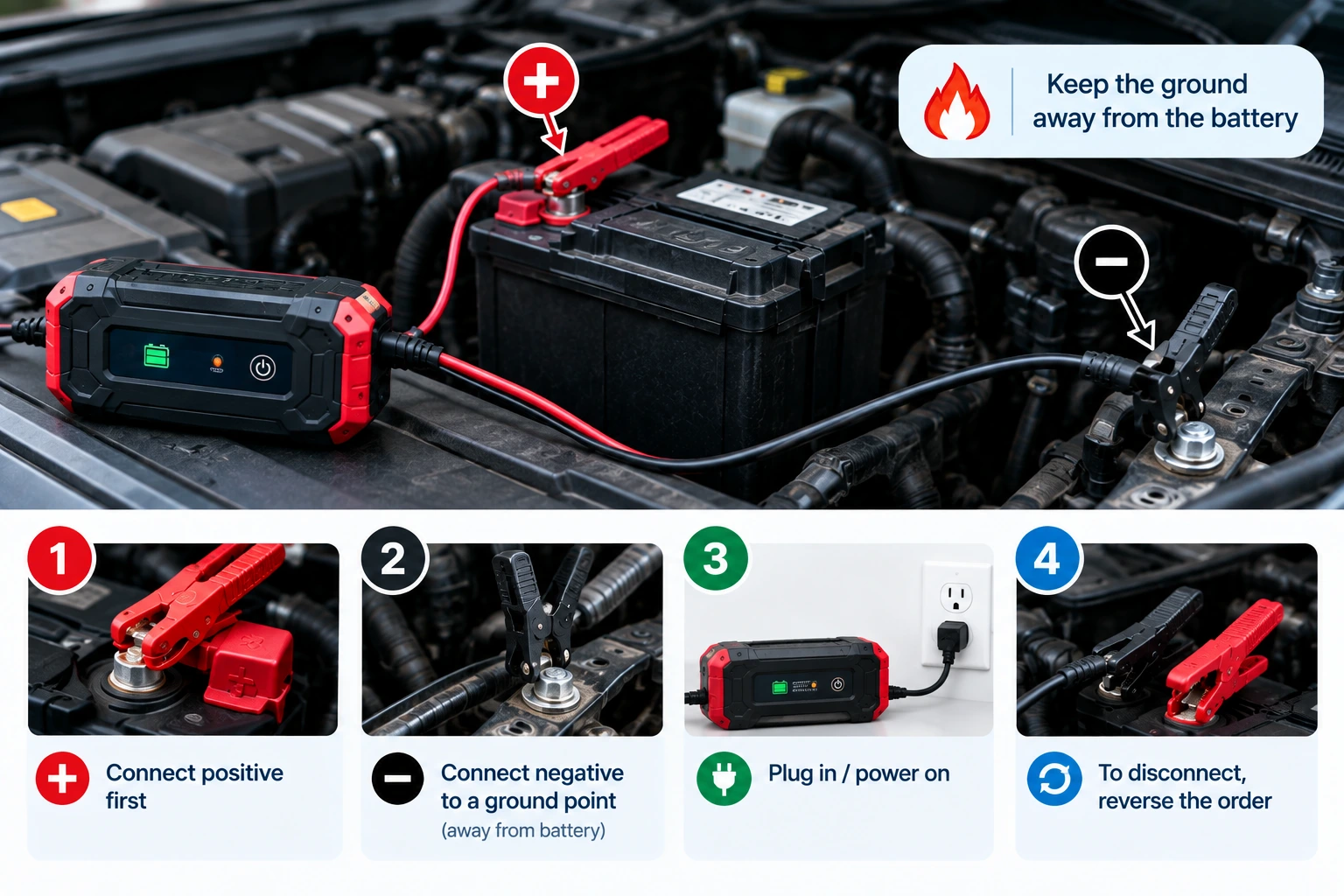
With the maintainer unplugged and powered off, connect the positive (red) lead to the battery’s positive terminal first. Then connect the negative (black) lead, but not to the battery’s negative post directly. Route it instead to a clean, unpainted piece of metal on the engine or chassis, a bolt on the frame or an engine bracket works, away from the battery itself.
The reason is straightforward. Charging a lead-acid battery releases hydrogen gas, which is flammable and can be explosive in the right concentration in the air right around the battery case. The Canadian Centre for Occupational Health and Safety (CCOHS) recommends making the final connection to a ground point away from the battery specifically so that any small spark from that last clip happens away from wherever hydrogen gas may be concentrated, not at the battery itself. Only after both clamps are secure do you plug in or power on the maintainer. To disconnect, reverse the sequence: power off and unplug first, then remove the negative lead, then the positive.
Ring terminals vs alligator clips: the real difference
Most smart maintainers ship with two connection options, and which one you use changes how the device actually gets used.
Alligator clips are fast to attach and require no permanent modification to the car, which makes them fine for an occasional, supervised top-up where you are opening the hood anyway. They are not a great fit for a connection meant to sit for weeks, since the clips can work loose with vibration and every reconnection means opening the hood and finding the terminals again.
A ring-terminal pigtail, the fused lead with two ring connectors you bolt permanently onto the battery posts, solves that. Once installed, the pigtail ends in a small, weatherproof plug that sits somewhere accessible near the front of the engine bay or under the hood edge. Reconnecting the maintainer becomes a matter of plugging in that connector, no hood-opening, no re-finding the terminals, no repeated wear on the clips or posts.
| Alligator clips | Ring-terminal pigtail | |
|---|---|---|
| Setup | None, clip on directly | One-time bolt-on install |
| Best for | Occasional, supervised top-ups | Long, unattended stays |
| Reconnecting later | Open hood, find terminals each time | Plug into the weatherproof connector |
| Vibration risk over weeks | Higher, clips can loosen | Lower, bolted connection |
A device you have to open the hood for tends to get used twice a year. A device with a permanent plug tends to actually get used. If you already know the car is going to sit for a season, install the pigtail once and the rest of this becomes routine.
Where the charging unit itself should live
The battery terminals get most of the attention, but the maintainer unit itself needs a sensible home too, especially for a connection meant to last unattended.
Keep it out of the engine bay proper. Under-hood temperatures swing far wider than the unit’s electronics are built for, and vibration and heat both shorten the working life of any electronic device parked there long-term. Most maintainers are designed to sit elsewhere, on a shelf, in a garage, on the ground beside the car, connected through a lead run to the battery or to the ring-terminal pigtail.
Keep it off wet or low ground. Standing water, melting snow, or a puddle after rain is a real risk for a unit sitting directly on a garage floor or driveway. Elevate it, hang it, or set it on a shelf rather than leaving it flat on the ground, and route the cable so water cannot pool in any connector along the way.
Keep it away from direct fuel or oil exposure. A maintainer left near a workbench with solvents or fuel containers nearby is a bad habit worth breaking regardless of the specific device.
Ventilation around the battery
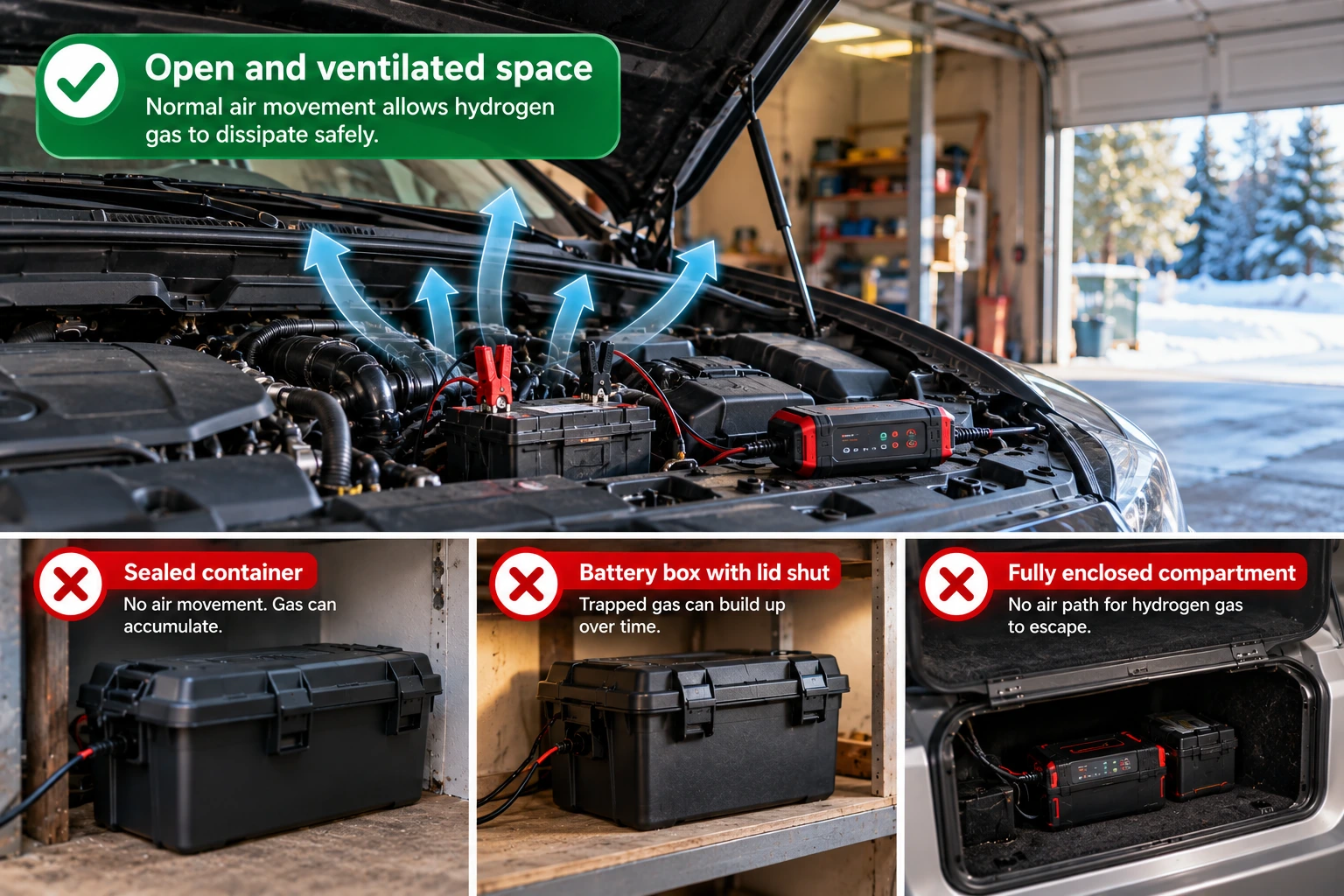
Because charging a lead-acid battery produces hydrogen gas, the space around the battery needs normal air movement for the whole time the maintainer is connected, not just while you are standing there watching it. A garage with the door occasionally opened, a carport, or any space with ordinary air exchange is fine. A sealed, unventilated container, a battery box with the lid latched shut, or a fully enclosed compartment with no air path is not, since gas can accumulate there over a long, unattended connection in a way it would not in open air.
This is one more reason a permanent under-hood connection often works better than an enclosed aftermarket battery box for a car that sits for weeks: the hood itself is not airtight, and normal under-hood air movement is enough for a low-current maintainer connection. If your battery lives somewhere more enclosed, confirm with that enclosure’s own documentation that it is rated for a maintainer left connected.
The walk-away checklist
Before you leave a maintainer connected for weeks rather than a day, run through this once:
- Confirm the connection is the permanent type, ring terminals or a pigtail, not clips you would rather not trust for a month unattended.
- Confirm the maintainer’s indicator shows a normal state, whatever your specific unit’s manual describes as charging or maintaining, not an error or fault light.
- Confirm the unit itself sits somewhere dry, ventilated, and out of the engine bay, not resting on wet ground or wedged under the hood.
- Confirm you are using the correct battery-type setting if your maintainer offers one. AGM, gel, and lithium batteries can call for a different charging profile than standard flooded lead-acid, and getting this wrong is a manufacturer’s manual question, not something to guess at. Check both the battery’s documentation and the maintainer’s own manual.
- Set a rough mental check-in date anyway. A smart maintainer is built to be left alone, but a car you are not going to see for months is still worth a glance if you happen to be near it.
For the broader question of which device you should even be using, a maintainer, a plain trickle charger, or a full charger, our device breakdown covers the distinction this whole connection procedure assumes you have already made. If your specific situation is a car that sits for extended periods, our guide to battery maintainers for a parked car covers the wider decision. And if a solar panel is the maintainer you are connecting, see our companion piece on solar trickle chargers and the blocking diode check before you wire it in, since a missing diode changes what “safe to leave connected” actually means. For the reactive side of a dead battery, our independent buyer’s guide to portable jump starters is the place to start, and if you are trying to build a habit around a jump pack instead, how often to recharge a jump starter in storage covers a similar set-and-forget routine for that device.
FAQ
Can I just clip a maintainer on and leave for a month?
Alligator clips can work loose over weeks of vibration, so a permanent ring-terminal connection is the more reliable choice for a genuinely long, unattended stay. Either way, confirm your specific maintainer is a true smart maintainer designed to be left connected, not a plain trickle charger that needs monitoring.
Which terminal do I connect first?
Positive first, then negative, with the negative lead routed to a clean, unpainted ground point away from the battery rather than the battery’s own negative post. Reverse the order to disconnect: negative removed after the unit is powered off, positive removed last.
Why does the negative lead go somewhere other than the battery?
Charging a lead-acid battery releases hydrogen gas near the battery case. Making the final connection away from the battery keeps a small spark, if one occurs, away from wherever that gas may be concentrated.
Do I need a ring-terminal harness, or are clips fine?
Clips are fine for occasional, supervised top-ups. A ring-terminal pigtail is the better choice for a car that sits for weeks or months, since it avoids repeated hood-opening and reduces the chance of a clip working loose.
Where should the maintainer unit itself sit, not just the cables?
Somewhere dry, ventilated, and outside the engine bay, ideally not resting directly on the ground where water can pool. The under-hood environment’s heat and vibration are harder on the unit’s electronics than a shelf or wall mount nearby.
Does an AGM or lithium battery need a different setting?
Often, yes. Many maintainers offer a battery-type selector, and using the wrong one can undercharge or overcharge that battery type. Check both your battery’s documentation and your maintainer’s manual rather than assuming a standard lead-acid setting is correct.
Is it safe to charge in a closed garage?
A garage with normal air movement, the door occasionally opened, or any ordinary ventilation is fine. A fully sealed, airtight enclosure with the battery inside is the situation to avoid for any unattended connection.
Reviewed: August 2026. This article describes the standard connection method for smart battery maintainers generally, not a test performed by this site. Follow your specific unit’s and battery’s own manuals for exact settings, and consult a qualified professional for anything the manual does not cover.