
kPa on a car vacuum’s box measures sealed suction: the pressure the motor can generate when the
nozzle is completely blocked and no air is flowing at all. That is not a cleaning condition, it is
a stress test the motor is never actually in while you use it. Real cleaning depends on airflow
moving through an open nozzle, which the kPa number does not describe. A high kPa figure alone
does not tell you how well a vacuum will clean.
Where the Number Comes From: Sealed Suction, Explained
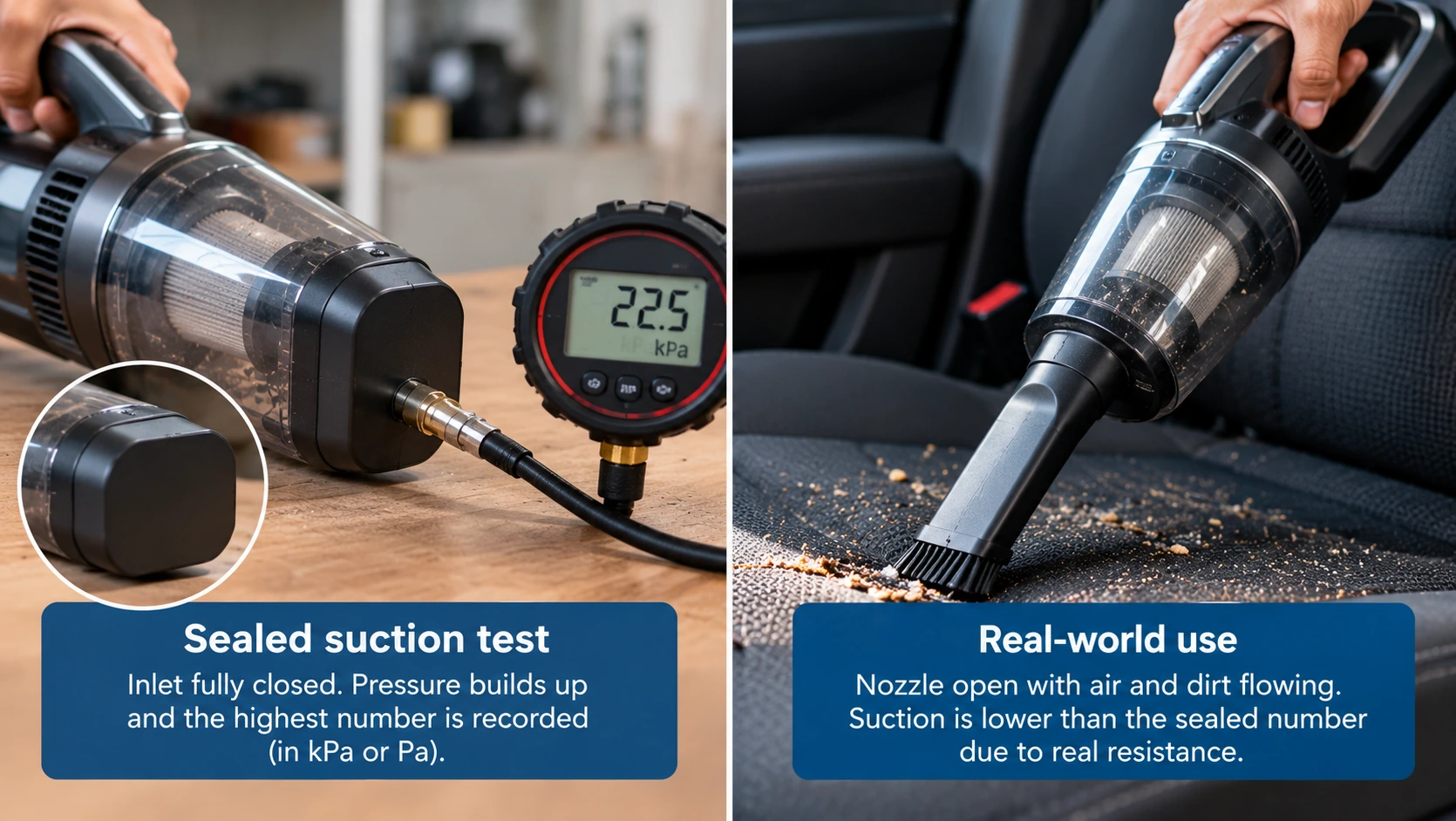
Manufacturers measure a vacuum motor’s sealed suction by running it with the inlet fully closed.
With nothing able to pass through, pressure builds behind the blockage and that pressure is what
gets reported in kilopascals or pascals. It is a legitimate engineering measurement of the motor
itself, not a fabricated number, but it describes one specific, extreme condition rather than the
range of conditions a vacuum actually meets on a car seat or floor mat.
The reason it ends up on the box instead of a more useful figure is simple: it is the biggest
number the motor can produce, because a fully sealed nozzle is the one state in which the motor
faces zero resistance from moving air. Every other test condition, with the nozzle open and dirt
and air actually flowing, produces a lower number. A spec sheet built to sell a product will
naturally choose the highest defensible figure it can print, and sealed suction is almost always
that figure.
Why Sealed Suction Is a Condition Where the Vacuum Is Cleaning Nothing
This is the part sellers do not spell out. If the nozzle is sealed and no air is moving, the
vacuum is not lifting dust, pulling crumbs out of a seat seam, or drawing sand off a floor mat. It
is pulling against a dead end. The kPa figure on the box is, by construction, measured at the one
moment when the machine is doing zero cleaning work.
That does not make the number meaningless. A motor that can generate strong pressure against a
blockage is also generally a capable motor overall, and sealed suction correlates loosely with
motor strength. But “loosely” is the operative word. Two motors can post similar sealed-suction
numbers and perform very differently once air, hair, dust, and gravel are actually moving through
them, because sealed suction says nothing about how the motor behaves when it is doing its job
instead of fighting a wall.
Airflow: The Number That Actually Predicts Cleaning
The figure that more directly predicts real cleaning is airflow, the volume of air the vacuum
moves through an open nozzle over time. Airflow is what physically carries loosened dirt away from
a surface and into the collection bin. A vacuum needs enough pressure to break debris free from
carpet fibers or a seat crevice, and enough airflow to then carry that debris somewhere. Suction
without airflow can grip a surface but move nothing off it. Airflow without any suction pressure
behind it drifts past debris without lifting it. Both matter, and they work against each other in
motor design in a way that means neither figure alone tells you the whole story.
The practical problem for a shopper is that airflow is rarely printed on car vacuum packaging at
all, and where a figure is present it usually comes from the seller with no independent testing
standard behind it. This guide does not print a CFM, air-watt, or wattage figure for that reason:
no independent, currently verifiable source for one was found during research, and an unsourced
number would be worse than no number.
Why the Nozzle, Hose and Filter Restrict Everything Downstream
Even a strong, well-matched motor is only as good as everything the air has to pass through to
reach it. A narrow crevice tool, a kinked or undersized hose, or a filter with too little surface
area all act as bottlenecks that throttle both pressure and airflow before they ever reach the
carpet or seat. A vacuum with an excellent motor behind a poorly designed nozzle and a thin hose
can be a genuinely disappointing vacuum in daily use, no matter what its box says.
This is also why the same motor can be sold in different housings with meaningfully different real
performance. The attachment set, the hose diameter, and how much filter surface area sits between
the nozzle and the motor decide how much of the motor’s rated capability the reader ever actually
feels at the business end of the tool.
The Honest Buying Conclusion: What to Check Instead of the kPa Number
Because the printed kPa figure describes a condition the vacuum is never actually in while
cleaning, it is not a spec a reader can buy well on by itself. A more useful buying checklist:
- Attachments. A crevice tool, a brush head for upholstery, and a wide floor nozzle cover most
car interior cleaning tasks better than a single generic tip. - Filter access. A washable or easily replaceable filter that the reader will actually clean
regularly matters more over the vacuum’s life than its headline suction number, since a clogged
filter collapses real performance while the number on the box never changes. - Hose length and flexibility. A short, stiff hose is a daily annoyance no spec sheet captures.
- Bin capacity and how it empties. A vacuum that is a hassle to empty gets used less.
- Corded, cordless, or 12V. This decides how and where the reader will actually use it, and is
covered in full in this site’s guide to
corded, cordless, and 12V car vacuums.
For a broader look at what to expect from this product category overall, including runtime and
capacity realities, see portable car vacuums: what to realistically expect.
The Same Trick, Three Products: Peak Amps, Max PSI, Peak Suction
This is not the first time this exact pattern has shown up on this site, and it will not be the
last. Jump starters print a peak amp figure measured under conditions the pack is never actually
delivering current in during a real jump start, covered in
how many amps does a jump starter actually need. Tire
inflators print a max PSI figure with the same kind of gap between the headline number and working
performance, covered in tire inflator specs explained. Car
vacuums print sealed suction kPa. Three different products, the same marketing habit: report the
biggest defensible number, measured under a condition that does not resemble how the device is
actually used. The general version of this pattern, and how to read a spec sheet for any car
gadget with it in mind, is covered in
marketing numbers vs working numbers.
Recognizing the pattern once means recognizing it everywhere it appears on a box in this category,
including on the vacuum aisle at any car accessory shelf. For more on what actually belongs in a
useful cabin kit beyond the vacuum itself, see the
cabin gadgets pillar guide.
FAQ
Is a higher kPa always a better vacuum?
Not reliably. It correlates loosely with motor strength but is measured under a fully blocked,
zero-airflow condition that does not resemble real cleaning, so two vacuums with similar kPa
figures can perform very differently in practice.
What should I look for instead of kPa?
Attachment quality, easy filter access, hose length and flexibility, bin capacity, and whether the
power format (corded, cordless, or 12V) matches how you will actually use it.
Is CFM a better number than kPa?
Airflow (often described in CFM) predicts real cleaning more directly than sealed suction alone,
but it is rarely printed on car vacuum packaging with a verifiable independent source, so it
usually is not available to compare either.
Does a full dust bin actually reduce suction?
Yes, functionally: a full bin or a clogged filter restricts airflow and reduces real cleaning
performance, even though the sealed-suction number printed on the box never changes to reflect it.
Why do sellers only print the kPa number?
It is the largest defensible figure a vacuum motor can produce, since a sealed, zero-airflow
nozzle removes all resistance to pressure buildup. It is a real measurement, just not one that
describes actual cleaning conditions.
Is this the same issue as peak amps on a jump starter?
Yes. It is the same underlying habit: report a number measured at an extreme, rarely-used
condition rather than a number that describes ordinary performance. Jump starters, tire inflators,
and car vacuums all show a version of it.