
No. An EV charger draws a large, steady current for many continuous hours, a duty ordinary household extension cords are not built or rated for. The Electrical Safety Foundation International states plainly: never use an extension cord or multiplug adapter when charging an electric vehicle. Most vehicle manufacturers’ own manuals say the same. If the outlet is out of reach, the fix is a properly installed outlet or circuit, never a longer cord.
Written by Emran Russell, who holds a Diploma in Engineering in Power Technology from Feni Polytechnic Institute and trained in vehicle diagnostics at TWEEN Automobile School. This article explains a safety principle, not a test performed on any specific cord or vehicle. Your vehicle, your charging cable and your home’s wiring may differ from what’s described here; check your owner’s manual and consult a licensed electrician for anything specific to your setup.
The Core Reason: Continuous High Current vs. Intermittent Household Loads
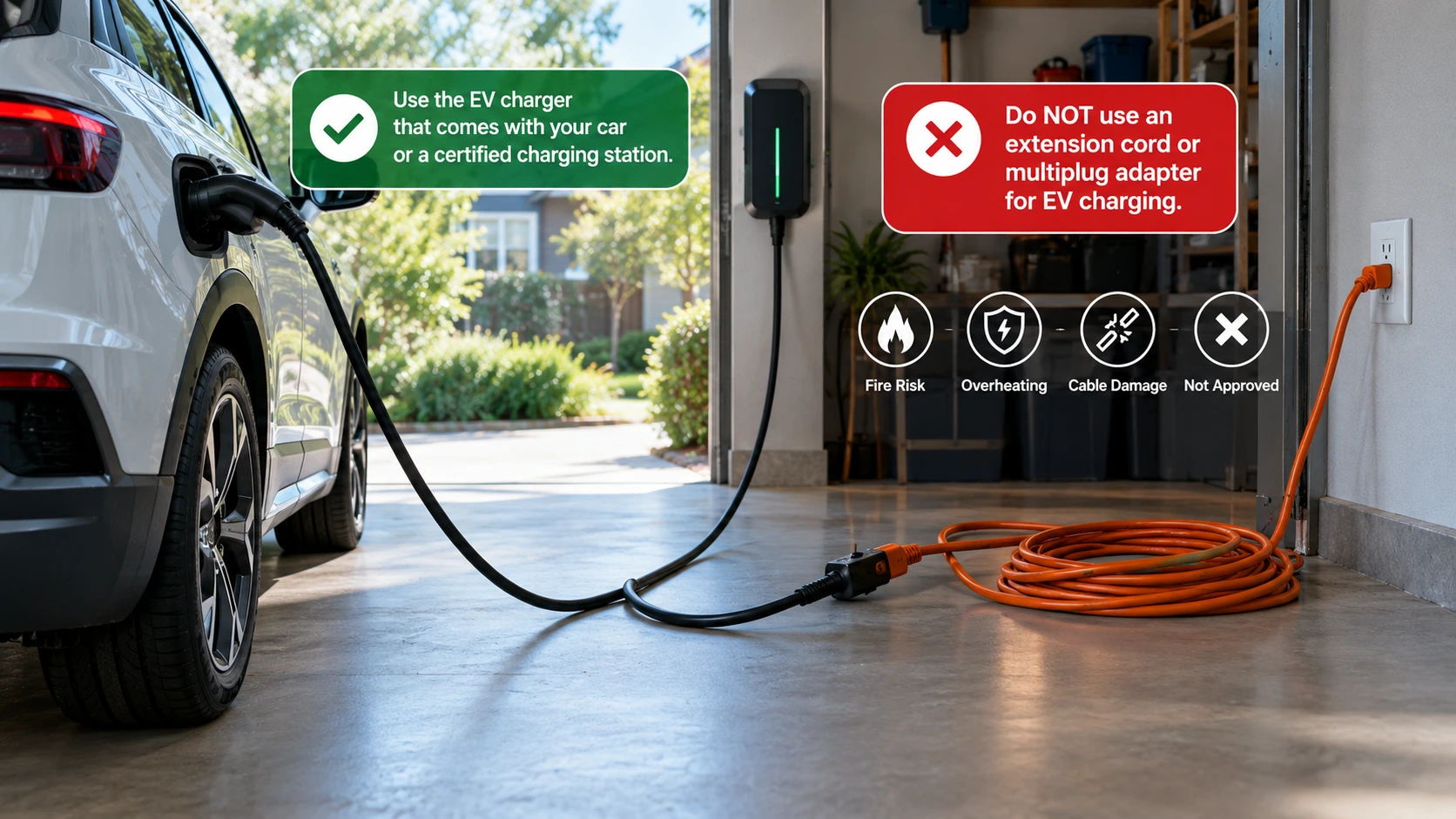
Household extension cords are designed and sold for intermittent loads: a drill running for a few minutes, a string of lights, a vacuum used in bursts, on and off, on and off. An EV charger, whether Level 1 or Level 2, draws a steady, continuous current for many hours in a row, often the entire length of an overnight charge. That is a completely different duty than the one an ordinary extension cord was engineered and tested for. The Electrical Safety Foundation International (ESFI) is direct about this: never use an extension cord or multiplug adapter when charging an electric vehicle, and only use manufacturer-provided or approved charging equipment. This is not a fussy technicality; it is the specific reason the failure mode for EV charging through an extension cord is a fire risk rather than a tripped breaker and an inconvenience. This rule recurs across the site’s wider EV and efficiency gadgets guide, which flags it as the one safety rule that repeats across nearly every charging-related gadget in the category.
Where the Heat Actually Builds: Every Junction Adds Resistance
Every place two conductors meet, a plug’s prongs seated in an outlet, a cord’s molded joint, a splice, the far-end connector, has some amount of electrical resistance, and under a basic and well-established electrical principle, resistance carrying current generates heat. A vehicle’s own charging cable, whether the cordset that came with the car or a purpose-built Level 1 or Level 2 unit, is engineered as one matched system: the cable, the plug and the control box that handles the safety and signaling functions are designed and tested together as a unit. Adding an extension cord inserts a second, unmatched set of junctions into that system, junctions the engineering never accounted for, and under a continuous multi-hour load, even a small amount of extra resistance at one of those points has hours to build heat rather than a chance to cool between short bursts of use. The same physics governs a much smaller cable, covered in car charging cable overheating: heat aging, connector strain, and a cable that is the wrong one for the power running through it. An EV charging cord fails the identical way, at a scale where the consequences are far larger.
Why Coiling the Cord Makes It Worse
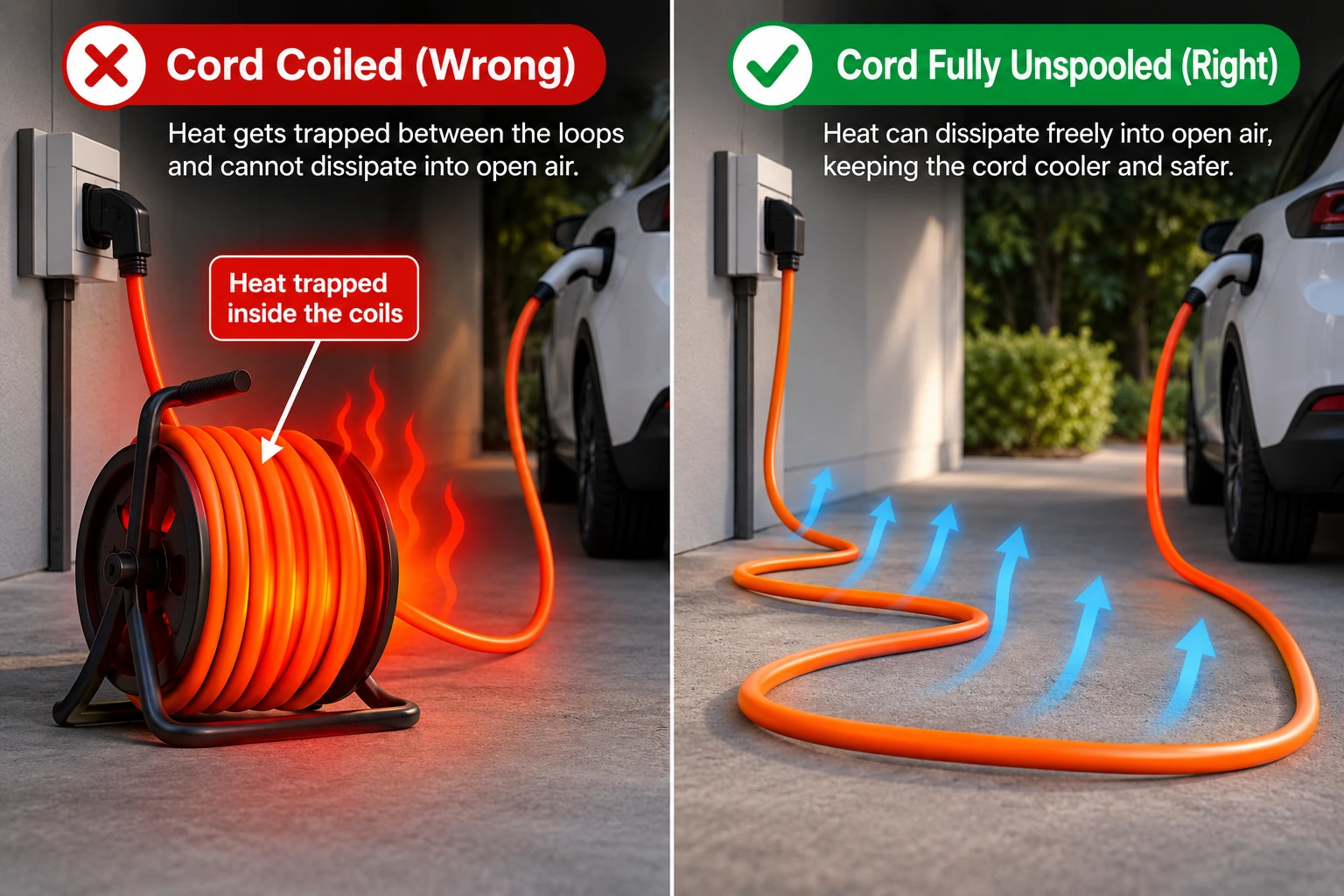
A cord left coiled or wound on a reel while carrying current cannot shed heat the way a fully unspooled cord can; the loops sit against each other, trapping heat that would otherwise dissipate into open air. This is why extension cord manufacturers themselves routinely instruct users to fully unwind a cord before connecting any sustained load, particularly a high-power one. For a short burst from a power tool, a partially coiled cord rarely matters in practice. For an EV charging continuously for hours, it removes one of the few things working in the cord’s favor, and combined with the junction-heating problem above, it is one more reason an extension cord is the wrong tool for this specific job, not a minor inconvenience to work around.
Outdoor and Damp Conditions Add a Separate Risk
Charging often happens in a driveway or carport, outdoors, sometimes in damp weather, and that adds a risk that is entirely separate from the continuous-load problem. Household extension cords are frequently not rated for outdoor or wet-location use at all, and moisture at any of the junctions described above turns a heat risk into a shock risk too. ESFI’s own EV charging guidance calls for proper GFCI (ground-fault circuit interrupter) protection specifically to guard against this, and recommends that all EV charging equipment be installed by a qualified electrician and be certified by a nationally recognized testing laboratory. An outdoor-rated cord is not a workaround for continuous EV charging; it addresses only the moisture problem, not the sustained-current problem described above.
What Vehicle Manuals Actually Say (and the Narrow Exceptions)
Most vehicle manufacturers’ own owner’s manuals explicitly instruct against using an extension cord, power strip, splitter or surge protector with the vehicle’s charging equipment, and that instruction is the one that actually governs your specific car, not a general article like this one. Be honest about the exceptions too: some manufacturers do publish a narrow allowance for a specific, named heavy-duty cord under specific conditions, in that vehicle’s own manual. If your manual states such an exception, it applies exactly as written, to that exact cord, and nothing else, not to whatever cord happens to be in the garage. If your manual is silent on the question or simply says not to, that instruction is the one to follow, not a forum post or a seller’s product page claiming otherwise.
The Real Alternatives
If the outlet you need is out of the cable’s reach, the actual fix is a properly installed outlet or dedicated circuit closer to where the car parks, done by a licensed electrician, not a longer cord. What that outlet itself needs to be, grounded, on a dedicated circuit, in good physical condition, is covered in the portable Level 1 EV charger guide; if the real issue is charging speed rather than reach, a properly specified Level 2 installation is the honest next step, and what a plug-in Level 2 unit needs from the building is covered in the portable Level 2 charger requirements guide. One more thing worth knowing before you trust any cord’s printed wattage number: that number is often a peak or intermittent rating, not a rating for continuous duty, the same gap between a headline number and a working number this site names across other product categories in peak vs. continuous ratings, explained. A cord rated for a wattage on its packaging was very likely never tested against hours of continuous EV-charging current at all.
FAQ
Is it ever safe to use an extension cord to charge an EV?
No, as a general rule. The Electrical Safety Foundation International explicitly advises against it, and most vehicle manufacturers’ manuals say the same. A narrow, named exception can exist in a specific manual for a specific heavy-duty cord; if yours does not say so, the answer is no.
Why is an EV charger different from other things I plug into an extension cord?
Most household devices draw power in short bursts. An EV charger draws a steady, continuous current for many hours in a row, which gives any weak point in the circuit far more time to build heat than an intermittent load ever would.
What actually happens if I use the wrong cord anyway?
Resistance at any loose or unmatched connection converts to heat under sustained current, and that heat can damage the cord’s insulation, the connectors, or in the worst case start a fire at a junction nobody is watching. It is not a hypothetical; it is the specific mechanism safety organizations warn about.
Does coiling the cord really matter that much?
Yes, for a sustained load. A coiled cord traps heat that a fully unspooled one can dissipate into open air, which compounds the risk already created by carrying continuous high current through unmatched junctions.
My charger’s cable is a bit short. What should I actually do?
Have a licensed electrician install a properly rated outlet or dedicated circuit closer to where the car parks. That is the legitimate fix; a longer extension cord is not, regardless of its printed wattage rating.
Does my vehicle’s manual really matter more than general advice like this?
Yes. This article explains why the rule exists and applies broadly, but your own manual, your vehicle manufacturer, and a licensed electrician are the authorities on your specific vehicle, cable and home wiring, not a general article.
Is a heavy-duty or outdoor-rated extension cord any safer for this?
An outdoor-rated cord addresses moisture exposure, and a heavier-gauge cord addresses some resistance, but neither one is automatically approved for continuous EV charging duty. Check your vehicle’s own manual for whether any exception applies before assuming a “heavy-duty” label covers you.