
Your car is already filtering the air you breathe every time you drive. The cabin air filter sits in the HVAC intake and cleans the outside air before a powerful blower pushes it through the cabin in large volume. A plug-in purifier moves a very small volume of air through a very small filter using a tiny fan. On that comparison alone, the built-in system does the overwhelming majority of the work in almost every car.
Written by Emran Russell, who holds a Diploma in Engineering in Power Technology from Feni Polytechnic Institute and trained in vehicle diagnostics at TWEEN Automobile School. No health or filtration-efficacy claim in this article is made without a named source, and your own vehicle’s setup may differ.
The Short Answer: The Car Is Already Doing This
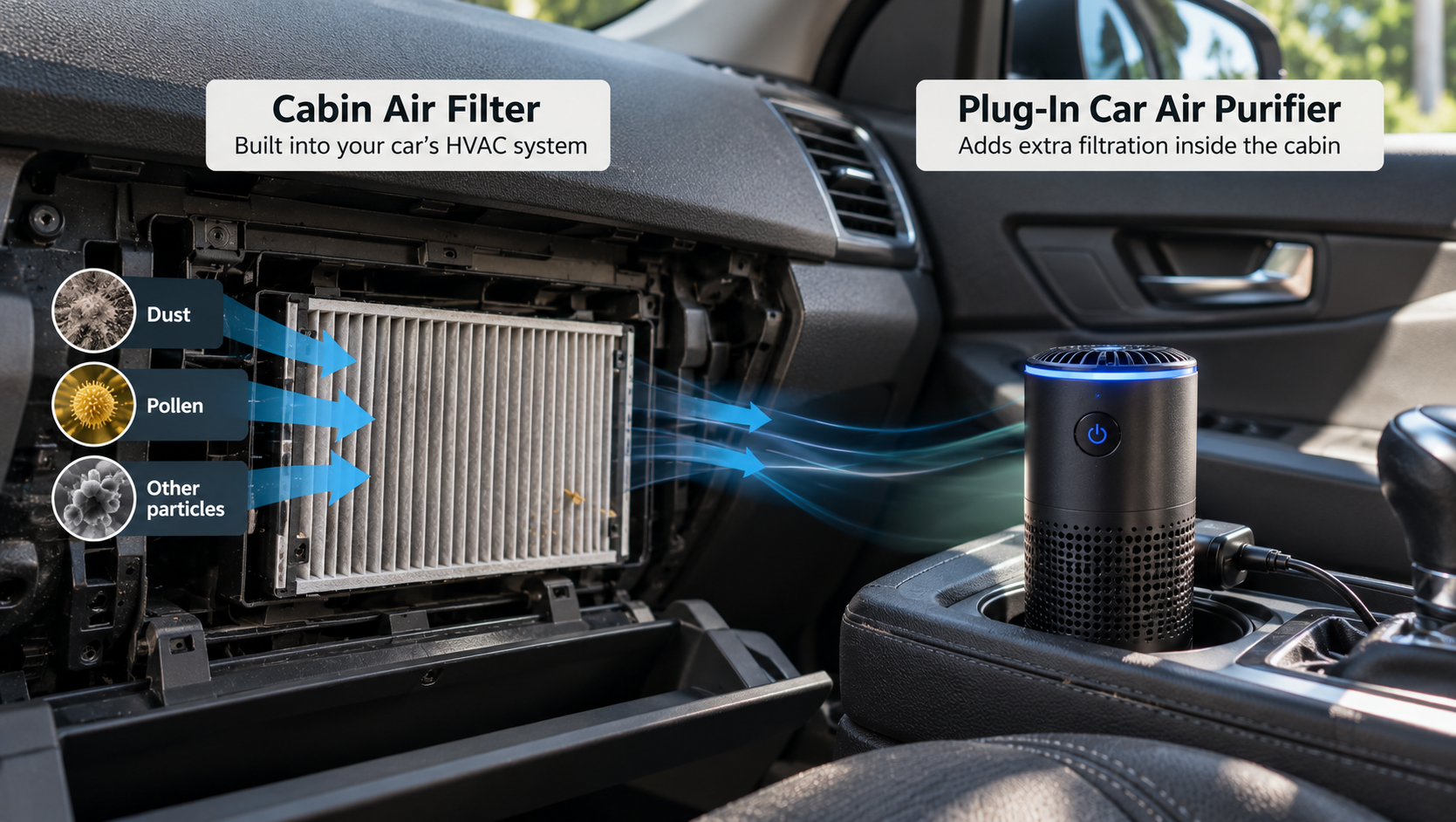
Before comparing devices, it helps to say plainly what most buying guides don’t: for the large majority of drivers, the car’s own system is already doing the job a plug-in purifier is being sold to do. That’s not a reason to dismiss every plug-in device outright, but it is the right starting point, because it reframes the question from “which one should I buy” to “does my situation actually have a gap the built-in system leaves open.” The rest of this article works through that question honestly, including the specific, narrower cases where a plug-in device does add something real.
Where the Cabin Filter Sits and What It’s Specified to Catch
The cabin air filter sits in the ductwork that feeds your car’s HVAC system, most commonly behind the glove box or, on some models, under the hood near the base of the windshield. When the system is set to draw in outside air, that air passes through this filter before it reaches the blower and, from there, the vents. The filter is specified to trap dust, pollen, mold spores, road soot and other airborne particulate carried in from outside, which is why it sits directly in the intake path rather than anywhere else in the cabin. How often to replace it, and how to do it, is a maintenance question that depends on your specific vehicle and driving conditions. Check your owner’s manual, and have a qualified mechanic handle it if you’re not doing your own maintenance; that’s outside what this article covers.
What a Plug-In Purifier Actually Does Differently
A plug-in cabin purifier works on a different slice of the problem entirely. Instead of filtering air as it enters the car, it draws in air that’s already inside the cabin, passes it through its own small filter or an ionizing element, and releases it back into the same space. It’s a recirculating device, not an intake device, which means it never touches the outside air the cabin filter is specified to clean. For the fuller breakdown of filtration versus ionizing purifiers and the ozone question that comes with some ionizing designs, see our dedicated guide to whether car air purifiers work, which this article deliberately doesn’t repeat in full.
The Comparison That Matters: Air Volume, Not Feature Lists
Most comparisons of these two stop at “they do different jobs” and leave it there. The comparison that actually decides whether a purifier is worth adding is volume. Your car’s HVAC blower is a purpose-built component that moves a large volume of cabin air through a correspondingly sized filter, continuously, every time you drive with the system running. A plug-in purifier’s fan is small by necessity, since it has to fit in a cup holder or a vent-mounted housing and run off a 12V socket, and it moves a correspondingly small volume of air through a correspondingly small filter. Stated plainly: in almost every car, almost all of the actual air filtration happening in the cabin is being done by the factory system, not the plug-in device sitting in the cup holder.
| System | Air volume moved | Filter size | What it filters |
|---|---|---|---|
| Car’s own HVAC + cabin filter | Large, continuous while driving | Sized to the vehicle’s full airflow | Incoming outside air: dust, pollen, mold spores, soot |
| Plug-in purifier | Small, limited by a compact fan | Small, sized to fit the unit | Recirculated cabin air already inside |
The Honest Gaps a Plug-In Device Could Address
None of this means a plug-in purifier never adds anything. There are a few specific, narrower cases where it can genuinely help. Some older vehicles, and some current base-trim models, were built without a cabin air filter fitted at all; in that situation, a purifier is filtering air the car itself isn’t filtering on the way in, which is a real gap rather than duplication. Recirculation behavior matters too: when the HVAC is set to recirculate cabin air rather than pull in fresh outside air, the cabin filter isn’t in the loop at all, and a purifier running continuously in that same recirculated air is doing something the filter briefly isn’t. And a specific, localized odor, say, from one passenger’s shoes or a spill that hasn’t fully cleared, sits in the cabin air itself rather than arriving from outside, which is exactly the kind of thing a recirculating device is positioned to work on, even at small volume.
The Recirculate Button: Free, and More Effective Than Most Gadgets
The most underused air-quality control in most cars costs nothing and is already built in: the recirculate button. Switching to recirculate stops pulling in new outside air, which is useful in stop-and-go traffic behind another vehicle’s exhaust, in smoky conditions, or any time outside air quality is worse than what’s already in the cabin. It’s the one control that directly changes how much unfiltered or lightly filtered air is entering the space you’re breathing in, and it does it instantly, at no cost, with no device to buy or maintain. Most drivers never touch it except by accident. Understanding when to use it does more for cabin air quality in the moments that matter, like sitting in traffic, than a plug-in purifier running quietly in the background ever will.
So Do You Need One? Matching the Device to the Situation
For most drivers, in most cars, the honest answer is that the car already handles this, and the money is better spent elsewhere; a working cabin filter and knowing when to hit recirculate cover the large majority of everyday cabin air situations. A plug-in purifier earns a real place only in the narrower cases above: a vehicle with no cabin filter fitted, heavy reliance on recirculated air for other reasons, or a specific lingering odor in the cabin itself. If odor, rather than particulate, is actually the problem you’re trying to solve, our guide to getting a smell out of a car covers finding and removing the source, which usually matters more than any air device. And for the general discipline of judging any car gadget’s claims before buying, our Cluster 8 guide to choosing car accessories applies here as much as anywhere else. For the broader picture of which cabin gadgets are worth keeping in the car at all, see our cabin gadgets pillar guide.
FAQ
Do I need a car air purifier if my car already has a cabin air filter?
For most drivers, no. The car’s own HVAC system moves a much larger volume of air through a much larger filter than a plug-in device can, so the built-in system is already doing the bulk of the work. A purifier adds genuine value mainly if your vehicle has no cabin filter fitted, you rely heavily on recirculated air, or you’re dealing with a specific lingering odor.
What’s the actual difference between a cabin air filter and a car air purifier?
The cabin filter cleans outside air as it enters the HVAC system, in large volume, every time you drive. A plug-in purifier recirculates air already inside the cabin, through a much smaller filter or an ionizing element, and never touches the incoming outside air.
Does every car have a cabin air filter?
No. Some older vehicles and some current base-trim models were built without one. If you’re not sure whether yours has one, check your owner’s manual or ask a dealer or mechanic; this article doesn’t cover replacement intervals or how to check or change it, since that’s a maintenance question for your specific vehicle.
Is the recirculate button actually useful for air quality?
Yes. Switching to recirculate stops pulling in new outside air, which helps in traffic, behind another vehicle’s exhaust, or in smoky conditions. It costs nothing and changes cabin air quality faster than any plug-in device.
Will a plug-in purifier remove a bad smell from my car?
Rarely on its own, if the smell has a source. Odor gadgets, including purifiers, mostly treat the air, while a persistent smell is usually coming from a source in a material like carpet or upholstery. See our guide to getting a smell out of a car for the source-first approach.
Should I replace my cabin air filter instead of buying a purifier?
That’s a real maintenance question, but this article doesn’t advise on replacement intervals or how to do it, since that depends on your specific vehicle and driving conditions. Check your owner’s manual, or ask a qualified mechanic.
Are ionizing car air purifiers safe?
Some ionizing designs generate ozone as a byproduct, which raises health questions that deserve a named source rather than a guess. Our dedicated guide to whether car air purifiers work covers the ozone question in full, sourced to the relevant bodies.
[…] an air purifier and a moisture absorber solve different problems. Our comparison of cabin air filters and plug-in purifiers covers filtration; neither should be treated as a repair for water entering the […]