
Most odor gadgets fail because they treat the air, while a persistent car smell almost always comes from a source sitting in a material: upholstery, carpet, the underlay beneath it, a neglected cabin filter, or standing water somewhere it shouldn’t be. Find and remove that source first, clean the material, dry it completely, then ventilate. Only after that does a device genuinely help, and even then, only for what’s left over.
Written by Emran Russell, who holds a Diploma in Engineering in Power Technology from Feni Polytechnic Institute and trained in vehicle diagnostics at TWEEN Automobile School. This is general guidance, not a promise of a specific result, and your situation may differ depending on the material, the source and how long the smell has been sitting.
Why Your Gadgets Didn’t Fix It: Air vs a Source Problem
Almost every product sold as a car odor fix works on the air inside the cabin, not on whatever is causing the smell. A hanging fragrance covers a smell with a stronger one. A bag of activated charcoal or a can of odor absorber pulls some ambient odor molecules out of the air over time. Neither one touches a source sitting in a material, which is why the smell reliably comes back within a day or two of using either. If the source is upholstery that absorbed spilled milk, carpet that stayed damp after a wet dog rode home, or the foam underlay beneath the carpet holding water nobody can see, the air in the cabin will keep re-loading with the same smell no matter how much you treat it, because the actual source was never removed. This is the single idea that explains why readers who have tried three gadgets still have a smell: they treated the symptom in the air while the cause stayed exactly where it was. For a broader look at which cabin devices are genuinely worth keeping in the car and which aren’t, see our cabin gadgets pillar guide.
Find the Source First: Footwells, Under Seats, Trunk Well, Cabin Filter
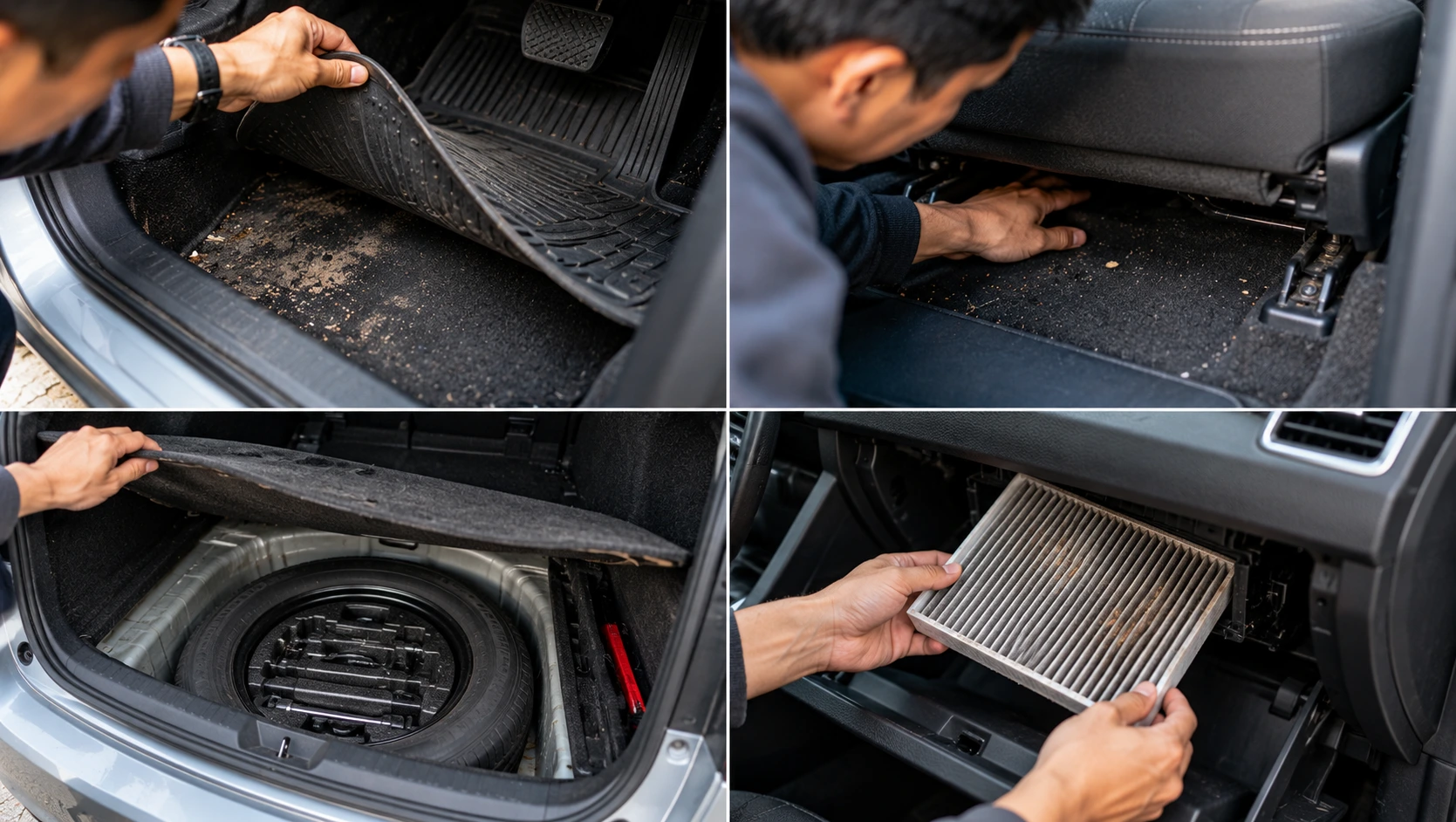
Before buying anything else, do a genuine search rather than a guess. Check the footwells and under the floor mats for anything spilled or tracked in and left to soak. Reach under the front and rear seats, where drinks, food and pet accidents commonly land and get forgotten. Open the trunk well and lift the trunk liner to check the spare tire compartment, a classic spot for a leaking container or water that got in during a wash or a storm and never dried. And check the cabin air filter, tucked behind the glove box or under the hood on most vehicles: a filter that has been sitting damp or has trapped mildew, leaves or debris can smell musty every time the blower runs, and it’s the most commonly overlooked source on this whole list, because it never occurs to most drivers to look at it at all.
Clean the Material, Not the Air
Once you’ve found the source, clean the material itself rather than spraying something into the cabin. For fabric and carpet, that means working a cleaner into the fibers, not just the surface, and extracting it back out rather than leaving it to evaporate on its own. A portable car vacuum earns its place here for the step that has to happen either way: pulling loose debris, hair and dried residue out of the fibers before any liquid cleaner goes in, since cleaning over dirt just relocates it. For an organic source such as urine, vomit or spilled milk, an enzyme cleaner does real chemistry that a general-purpose cleaner doesn’t: the enzymes break down the organic compounds causing the smell, rather than simply masking or diluting them, which is why enzyme products are the right tool for this category of stain specifically.
Dry It Completely, or the Smell Comes Back
Damp is the most common reason a smell returns after a cleaning that seemed to work. A car cabin dries far more slowly than a room in a house, because airflow is limited and carpet, seat foam and the underlay beneath both hold moisture for a long time once they’re wet. A surface that feels dry to the touch can still be damp several layers down, and that trapped moisture is exactly the environment mildew and mold need to keep growing. Point a fan into the cabin with the doors open, run the climate control on a dry, non-recirculated setting for a stretch, and don’t close the car back up until you’re confident the material is dry all the way through, not just on top. Skipping this step is the most common reason a cleaning job that looked successful smells musty again within a week.
Ventilate, Then Decide if You Actually Need a Device
With the source removed and the material clean and dry, give the cabin genuine airflow before reaching for anything else. Parking with the windows cracked, or driving with them down, exchanges the cabin’s air completely in a way no plug-in device can match, since it’s moving the whole volume of air in the car rather than filtering a slice of it. Many readers find that once the actual source is gone, there is nothing meaningfully left to treat, and no device is needed at all. If a faint, ambient smell persists after all of this, that’s the point where a device might genuinely help, not before it.
Sorting the Devices Honestly
Not all “odor gadgets” do the same job, and knowing which one you’re holding matters. The same discipline is worth applying to any car gadget’s claims, not just this category; see our guide to judging a car gadget before you buy it for the general version of this thinking.
| Device type | What it actually does | Where it genuinely helps |
|---|---|---|
| Fragrance (spray, hanging, vent clip) | Masks smell with a stronger one; removes nothing | Never a fix, only a temporary cover |
| Activated charcoal / odor absorber | Slowly pulls some ambient odor molecules from the air | Mild, lingering ambient odor once the source is gone; slow, not a source fix |
| Enzyme cleaner | Breaks down organic compounds in the material itself | Applied directly to the source: urine, vomit, food, organic stains |
| Ozone shock treatment | High-concentration ozone gas, used to strip odor from an unoccupied space | Professional use only; not a device to run with anyone inside the car |
Ozone deserves a direct warning rather than a footnote. The US EPA states plainly that no ozone-generating air cleaning device has been approved for use in occupied spaces, because ozone irritates and inflames the respiratory system and can worsen asthma. The California Air Resources Board lists ozone-generating air purifiers among hazardous products for the same reason. Professional detailers who offer an ozone shock treatment run it in an empty, sealed car and ventilate thoroughly before anyone re-enters. That’s a professional service with a controlled procedure, not a consumer gadget to run while you’re in the car, or even parked with the windows up.
Matching the Fix to the Smell
Smoke. Smoke odor clings to fabric, headliner and even hard plastic at a molecular level, which is why it’s one of the hardest smells to fully clear. Deep-clean every fabric surface, including the headliner and pillars, not just the seats, and expect it to take more than one pass.
Pets. Pet odor is usually a combination of dander trapped in fibers and specific accident spots. Vacuum thoroughly first, then treat any accident spot with an enzyme cleaner rather than a general fabric cleaner, since enzymes are built for exactly this kind of organic residue.
Milk or food. Spilled milk and food residue sour as they break down, and they’re a classic case of a source hiding somewhere you didn’t check, under a seat, in a door pocket, or down in a seat track. Find the actual spot before cleaning; treating the air around a hidden spill does nothing.
Damp and mildew. A musty smell after rain, a wet dog, or a leak points to trapped moisture, and it is worth taking seriously rather than just masking. Persistent mold exposure has been linked by the CDC and EPA to upper respiratory symptoms, coughing and wheezing, and worse reactions in people with asthma or mold allergy. If a musty smell keeps returning after you’ve cleaned and dried the cabin, or if you can see mold growth, that’s a job for a professional detailer with the equipment to fully extract and dry the affected material, not another gadget.
A sweet or chemical smell. This one is different from everything above. A sweet smell can point to coolant, and a strong chemical or fuel-like smell can point to a fluid leak, neither of which a cleaning product or an odor gadget will resolve, because the cause isn’t a cleaning problem at all. If you notice a smell like this, have a qualified mechanic look at the vehicle rather than treating the cabin.
FAQ
Why does my car still smell after I vacuumed and used an air freshener?
Because vacuuming and fragrance both work on what’s loose or in the air, and a persistent smell almost always comes from a source soaked into a material, like carpet, the underlay beneath it, or a seat. Until that source is found, cleaned and dried, the smell will keep coming back.
Do odor-absorbing gel or charcoal bags actually work?
For mild, ambient odor once the source is gone, they can help a little, slowly. They do nothing for a smell that’s still coming from a source sitting in a material.
Is it safe to use an ozone machine in my car myself?
No. The EPA states that no ozone-generating device is approved for use in occupied spaces, because ozone irritates the respiratory system. Ozone shock treatment is a professional service run in an empty, sealed car, not something to use with anyone inside.
How do I know if the smell is coming from the cabin air filter?
If the smell is strongest or only noticeable when the blower or air conditioning is running, the cabin filter is a likely source. See our comparison of a cabin air filter and a plug-in purifier for how the filter fits into your car’s airflow.
Should I buy a car air purifier to fix a bad smell?
Usually not as a first step. A purifier treats the air, and a persistent smell is usually a source problem. Our guide to whether car air purifiers work covers what these devices can and can’t actually do once the source is dealt with.
Can mold in a car actually make you sick?
Persistent mold exposure has been linked by the CDC and EPA to respiratory symptoms including coughing, wheezing and worse reactions in people with asthma or a mold allergy. A musty smell that keeps returning after cleaning and drying, or visible mold, is worth having a professional detailer look at rather than treating with another gadget.
How long should I let the cabin dry before closing the car up again?
There’s no single number that fits every car and every level of dampness; airflow, temperature and how saturated the material was all matter. The reliable check is whether the material is dry several layers down, not just on the surface, before you close the windows and doors again.
[…] odor remains, investigate the material producing it. Our guide to getting a smell out of a car explains why treating the source matters more than masking cabin […]