
Some car air purifiers work as advertised and some add a byproduct that irritates your lungs. It
depends entirely on the mechanism. Filtration devices physically capture particles and genuinely
clean air, in proportion to how much air actually passes through the filter. Ionization devices
charge particles so they settle out of the air rather than remove them from the car, and some
ionizing units generate ozone, which the US EPA and the California Air Resources Board (CARB) both
identify as a lung irritant.
By Emran Russell, Diploma in Engineering in Power Technology (Feni Polytechnic Institute), with
diagnostic training and garage experience. Your situation may differ from the general points
below; if you or someone in your car has asthma or another respiratory condition, talk to a
clinician about air quality devices rather than relying on this guide.
Two Different Devices: Filtration vs Ionization
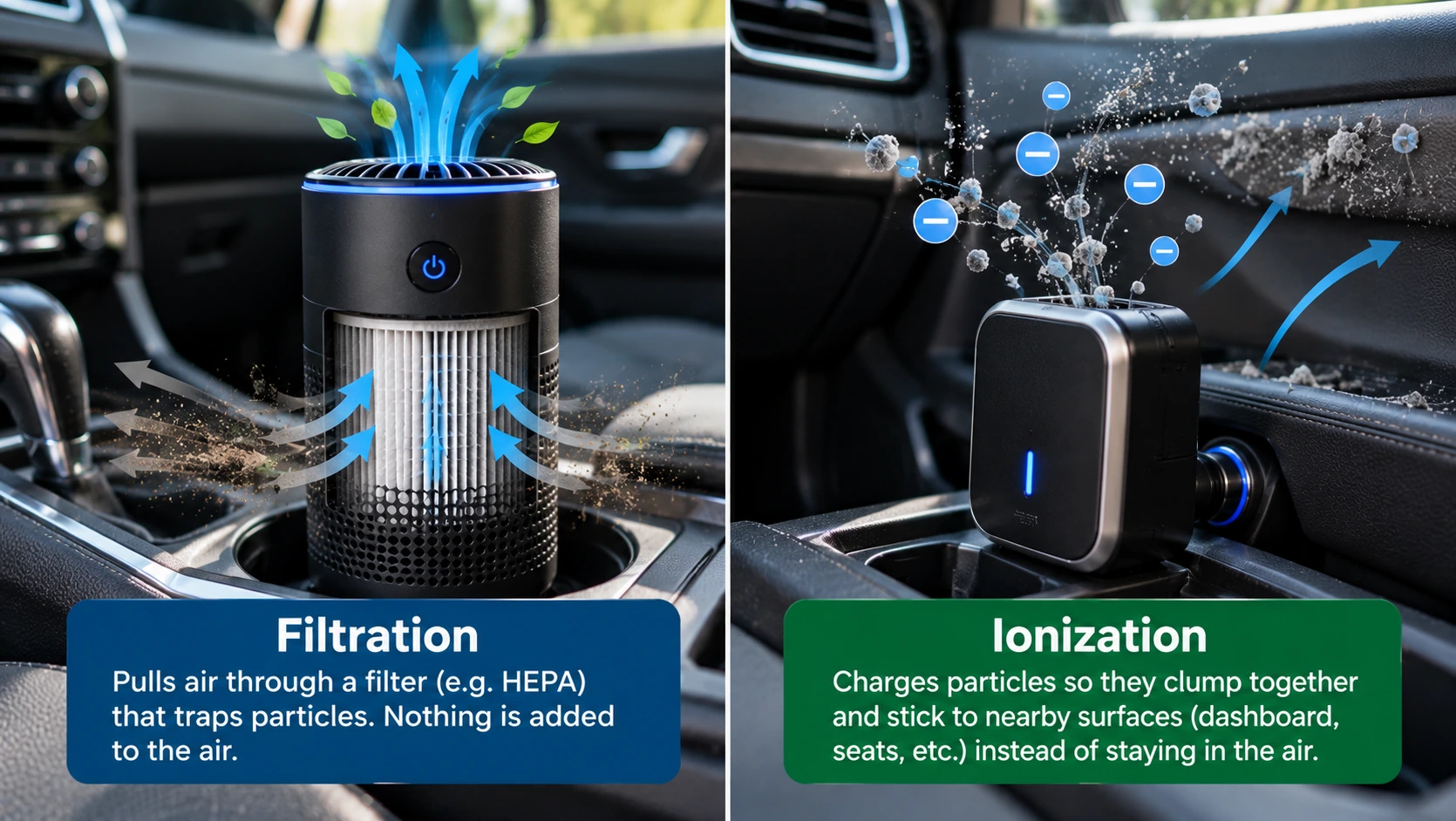
“Car air purifier” covers two genuinely different technologies sold under one label, and mixing
them up is where most confusion starts.
Filtration works the way an air filter works anywhere: air is physically pulled through a
medium (often a HEPA-type filter) that traps particles as it passes. Nothing is added to the air.
Effectiveness is a direct function of filter quality and, critically, how much air the device
actually moves through that filter.
Ionization works differently. It charges airborne particles electrically so they clump
together and are drawn to nearby surfaces (the dashboard, the seats, the car itself) rather than
staying suspended where you would breathe them. The particles leave the air you are measuring, but
they do not leave the car. Some ionizing devices also produce ozone as a byproduct of that process,
which is the separate, more serious concern covered below.
Knowing which one a product is doing before you buy it is the single most useful thing this guide
can tell you. For a wider view of which cabin gadgets earn a permanent spot in the car and which
don’t, see the cabin gadgets pillar guide.
Filtration: What a Cabin Purifier Can Actually Capture
A genuine filtration-based purifier can capture dust, pollen, and other airborne particles,
proportional to two things: the quality of the filter media and the volume of air actually moved
through it. This second point is the honest limitation of most small plug-in cabin units. A device
sized to fit a cigarette lighter socket or a cup holder is working with a small fan and a small
filter, moving a modest volume of air, inside a cabin that is itself not sealed the way a room is:
doors open, vents cycle outside air in, and the car’s own ventilation system is already moving far
more air than a small plug-in unit typically can.
None of that means filtration does not work. It means a small filtration device’s realistic
contribution is modest next to the cabin’s existing airflow, not that it does nothing. A larger
unit with genuine filter surface area and stated airflow will outperform a small novelty-sized one,
which is one more version of the working-numbers-over-marketing-numbers pattern covered across this
site’s buying guides.
Ionization and the Ozone Problem
This is the section where a brand-neutral site can say plainly what a purifier vendor generally
will not.
Ionizing air purifiers can generate ozone as a byproduct of how they charge particles. The US EPA’s
guidance on ozone generators sold as air cleaners states that ozone has little ability to remove
indoor air contaminants at concentrations that do not exceed public health standards, and that
inhaling ozone can irritate the respiratory system, cause chest pain and coughing, and worsen
asthma. CARB’s page on hazardous ozone-generating air purifiers goes further, stating that these
devices are largely ineffective at cleaning air at safe operating levels, that ozone does not
remove particles like dust or pollen, and that CARB strongly advises against using ozone generators
in spaces occupied by people or animals. CARB has regulated ozone emissions from indoor air
cleaning devices since 2007 and maintains a public list of devices of concern.
There is also published, peer-reviewed research specifically on this category: a 2024 study in the
journal Aerosol Science and Technology examined ionization-type car air purifiers under actual
driving conditions. This guide does not restate specific figures from that study since the full
text could not be independently verified for this article, but its existence confirms that
ionization-type car purifiers are an active, studied area, not a settled non-issue.
The practical takeaway: a filtration-only device carries no ozone risk by its mechanism. An
ionizing device might, and whether a specific product does depends on that product’s own design and
any certification it carries, which the manufacturer’s own documentation, not this article, is the
place to check.
Why Your Car’s Own Ventilation and Cabin Filter Already Do Most of the Work
Before adding a device, it is worth recognizing what the car is already doing. Every car built in
recent decades draws outside air (or recirculated cabin air) through a cabin air filter before it
reaches the vents, and that filter is doing continuous, whole-cabin filtration every time the fan
runs, at an airflow volume a small plug-in device cannot approach. A dirty or old cabin filter
undermines that baseline more than an added purifier is likely to make up for. The mechanics of
that filter, including how it differs from a plug-in purifier and when to replace it, are covered
in cabin air filter vs a plug-in purifier, which is the
right next stop if this is the actual question behind “should I buy a purifier.”
If You Buy One Anyway: What to Look For
If a reader decides a supplemental device is still worth adding, a short honest checklist:
- True filtration, stated plainly. Look for a named filter type (HEPA-type or similar) rather
than vague “purification” language with no mechanism named. - No deliberate ozone generation. If a product markets ozone output as a feature (for smell
removal or “deep sanitizing”), that is the exact category CARB and the EPA warn about. - A replaceable filter. A sealed unit with no serviceable filter degrades quietly and gives no
way to know when it has stopped doing useful work. - Realistic expectations for the size of the unit. A device that fits in a cup holder is not
going to out-perform the car’s own ventilation system; treat it as a supplement, not a
replacement.
For a broader framework on evaluating any car gadget’s claims against its actual mechanism, see
how to choose car accessories.
Odor Treatment Is a Different Problem
A separate and legitimate question often gets bundled into “air purifier”: removing a smell from
the car, whether from smoke, spills, pets, or mildew. Odor treatment is not the same problem as
particle filtration or ozone safety, and it has its own set of legitimate approaches and its own
pitfalls, including some of the same ozone-generating devices marketed specifically as odor
solutions. That full topic, including what actually removes a smell versus what temporarily masks
one, is covered in getting a smell out of a car.
FAQ
Do car air purifiers actually clean the air?
Filtration-based units genuinely remove particles, in proportion to filter quality and airflow.
Ionization-based units remove particles from suspension but not from the car, and some generate
ozone, which the EPA and CARB both identify as a respiratory irritant rather than a cleaning agent.
Are ionizing car air purifiers safe?
It depends on the specific device and whether it generates ozone as a byproduct. The EPA states
that ozone has little ability to clean air at safe levels and can irritate the respiratory system;
CARB advises against ozone generators in occupied spaces. Check a specific product’s own
documentation for how it is certified, and if you have asthma or another respiratory condition,
talk to a clinician before relying on one.
Is a plug-in purifier better than my car’s cabin air filter?
Generally no on its own. The cabin air filter processes far more air, continuously, every time the
ventilation fan runs. A small plug-in unit is realistically a supplement, not a replacement.
Will an air purifier remove smells from my car?
Some particle-based smoke or dust smells may reduce somewhat with genuine filtration, but general
odor treatment is a different problem with its own methods, covered separately in this site’s
odor-removal guide.
How do I know if a purifier uses filtration or ionization?
Check the product’s own description for the mechanism named plainly: a stated filter type (such as
HEPA-type) indicates filtration; language about ions, plasma, or “purifying the air” without a
named filter often indicates ionization, which is where the ozone question applies.
Does CARB or the EPA certify car air purifiers as safe?
CARB regulates ozone emissions from indoor air cleaning devices and maintains a public list of
devices of concern; it does not endorse specific products. Check a product’s own certification
claims against CARB’s and the EPA’s published guidance rather than taking a seller’s safety claim
at face value.